Showing posts with label employee engagement. Show all posts

3/25/2014

Have You Seen This Movie Before?

Intuition is the thing that’s often missing in communication. After all, if you have intuition about your audience (what they’ve experienced, their motivations, etc.) you can engage with them more effectively. And if you’re faced with a business decision about which you have to communicate, intuition is a guide that won’t let you down.

Call it a hunch – or, following your gut.

Intuition isn’t entirely learned, nor are you just born with it. As a journalist, I had to mentally process huge amounts of incoming data and decide what’s important to the reader or viewer and how to serve it up. It was important to be a quick study. 
It certainly helped that there was a lot of sameness in what we saw day-in and day-out: political scandals, shootings, fires, missing children, a hero’s homecoming. You felt like you’d seen this movie before.

Certainly much of my intuitive ability was cultivated and practiced in a newsroom. Intuition is one of the three pillars of Novaria Communication: intelligent, intuitive, influential. I help people communicate intelligently, with an intuition about their environment, and in a way that will influence their stakeholders. So imagine my delight when I read a piece in Huffington Post that says intuition is a highly valued attribute in the business world. The author explains how intuitive people cultivate and access their sense of “knowing.”


Intuition takes many forms, like knowing what’s going to happen next, like a feeling of déjà vu because you’ve experienced something so very similar before, like that comment you make and somebody else says “I was thinking the exact same thing.”

Intuition isn’t the only imperative for business and communications success, however. Some scenarios call for a more deliberate approach. I grew up in Missouri – the Show-Me State – where we took a little extra time and sized things up before coming to a conclusion. People say that Midwestern sensibility is a highly-valued attribute.

I think it comes down to being grounded. Experience helps. Having been through countless business transformations, counseling numerous executives and steering communications and engagement initiatives, I honestly believe that saying “there’s nothing new under the sun.” Yes, the people are different, the organizations are different, even innovation brings different ways of doing things, but the fundamental motivations are the same. People want the same outcomes – efficiency, ease, transparency, clarity, honesty.

Intuition tells me that. And it hasn’t failed me yet.

Today's question: How has intuition saved your bacon?
10/17/2013

The Failure Wall

Last week I told you about D&B Credibility and its uncommon approach to talent. I got a few raised eyebrows when I mentioned the company takes up to nine months to pull the trigger on a hire. CEO Jeff Stibel says it’s a good way to know that the employee is a perfect fit, and there’s a better chance of retention.

In the post-2008 economy, that can be good and bad. Good for an employer to resist the temptation to pluck the next adequate candidate from an overflowing talent pool. Bad for a job seeker who can’t afford to wait nine months while an employer is looking under the hood.

That said, there’s a lot to admire about this company and its culture – and most importantly, how effective communication is at the heart of employee engagement.

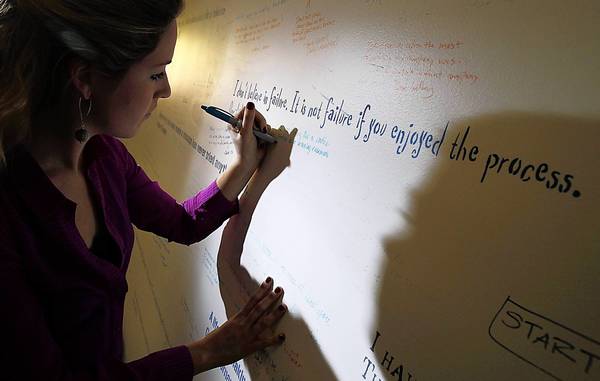
One unique feature of the D&B culture is the Failure Wall – a giant whiteboard on which employees are encouraged to write down an experience where they felt they came up short and what they learned from it.

The Failure Wall has been widely chronicled and celebrated. The LA Times wrote about it and Jeff blogged about it for Harvard Business Review. Naturally, both went viral, making this an overnight phenomenon.

A business leader I admired once told me “You learn the most from the job you didn’t get.” Most of us would admit that despite the sting of failure (or failing to meet expectations), we pick ourselves up off the floor and gain fresh insight and self-awareness.

Indeed, when I asked Jeff “What’s the D&B Credibility success story?” he simply replied “People. Admitting our failures and learning from them.”

He continued: “You learn the most from your failures. We encourage people to disclose their failures and discuss them. “

There’s something cathartic about admitting failure – or even admitting you’re having a bad day – and doing something about it. If a customer service rep has a negative experience with a customer, Jeff may tell that person to take the rest of the day off and come back refreshed tomorrow.

How many times have you said to a colleague: “That’s on me.” Or “My bad?” It felt good, didn’t it? Even better when you say, “Here’s what I can do to fix it.” Or “Here’s what we’ll do next time.”

Stibel has several degrees, one of which is brain science –  the interdisciplinary study of psychology, philosophy, artificial intelligence and neuroscience. So I suspect he’s applying what he learned at Brown University. Of course he leads by example and will admit his own failures. How many CEOs do you know or have heard of do that?

***

Note: I came across this phrase several times: “Mistakes are the predecessors to both innovation and success.” Curious to know where it came from, I Googled it. The result was 5,790 matches. I don’t know who first said it, but Jeff has done a nice job of making it one of his key messages.

Also:
- Company blog about the Failure Wall
- Jeff describes the Failure Wall (video)